DieselElectric™ Submarine Power Generator & Drive Train
Updated: Oct 3
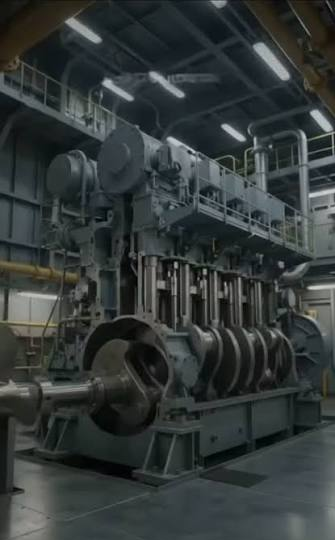
DieselElectric™ Technology Applications
Common, public domain knowledge governs all following observations. What one drive train does, such as that of a submarine could apply to any drive train.
Nuclear powered submarines (nuclear submarines) often seem to attract the interest of international, naval projection planners. The two main justifications for nuclear submarines are that they delivery a power density and an unbeatable energy density.
Power to weight ratio favours diesel-electric over nuclear power for submarine propulsion. Nuclear submarines can operate for extended months without refuelling or resurfacing, as they also restore the carbon dioxide scrubbers. That function is now enhanced by a technology breakthrough which will extract dissolved oxygen from water - the IronGill.
Power To Weight Ratio
Nuclear submarines produce a power to weight ratio of approximately 0.05 kW/kg of engine output.
Diesel-electric engines produce up to 0.25 kW/kg or power. Diesel-electric wins commandingly, on power to weight ratio.
Oxygen supply during combat conditions can be supplied via Xerqon Pty Ltd’s IronGill™ water scrubber technology. See the article about the IronGill. It features three surface breached submarines.
Lithium batteries produce sufficient power density. With a dense fly wheel material, the electric motors can sustain the angular momentum or torque produced by the diesel engine, or engines (where redundancy is considered).
The diesel engines and electric motors can work to produce most power surges via the diesel engines, and all cruising power from the electric motor and fly wheel combination.
To keep the vessel as quiet as practicable, the most thermoelectrically conductive copper carbide sponge-like mesh of 3 mm diameter gauge, would be used to sound dampen the engine bay. The engine should rest entirely within a surrounding array of large, road, motor vehicle, shock absorbers.
To further maintain the quietness of the vessel the propeller or fan should be replaced by a cowled fan, or better stated, a turbofan, for near silent cruising. Metal carpet floor surfacing will also improve quietness.
Electric engine revolution will control turbofan direction and rate of turbofan revolution.
The abundance of seawater enables the engine bay to be water cooled, and the heat dispersed to the human environment as hydronic heating. It would be an error to release the heat to the ocean environment, as the thermal spectrum signature may give away position.
Any other systems to be included may be necessarily top secret, for any party embarking on the system describe for military submarine application.
Further Development
One important capability to develop would be very streamlined, low depth, submersible cargo ships or goods ships, to weather heavy storms, while still crusing as advanced hybrid vessels. That saves the cargo and allows delivery time to be little affected. The whale shark's body would be the best model to guide the advanced performance vessel's shape.
Dimpling the entire surface allows for swifter movement through/over the waters suface in ship or submarine mode. Turbo fans rather than propellors or simple fans will also lend further assistance to propulsion. At low submersion depth, the low water pressure would still allow for swift movement. Sea transport has not looked so safe and sure.
Leisure Submarines (Vertical Market Integration)
The civilian submarine market offers substantially more in operating returns than the military market. Its power generator may be Xerqon's Halo Power. See the Xerqon blog article, Halo Technology - ‘HaloDrive’™ & ‘HaloPower’™ for details. The drive train may be even Halo Drive - creating a silent, swift and streamlined submarine leaving little wake.
A minimum of 125 mm of double-laminated, ForceGlass™, large portholes and one atmosphere of air insulation behind aluminium carbide are required enhanced features. The insulation layer will be divided into compartments for structural integrity. Large insulation panels would each be an array of air pockets, to line the inner vessel. It may will improve buoyancy where necessary. There is a Xerqon blog articles which elicits the technical schema for ForceGlass™.
The advancements will make the leisure craft cruising the most sought after marine experience on our stunningly beautiful planet.
The Great Barrier Reef day cruise experience is only the beginning. The deep seas off most coastal environments have comparable features to explore, including large marine fauna. Larger fins with larger ailerons, working simultaneously with tailerons, will provide more stability and manoeuvrability.
© Xerqon Pty Ltd 2026


Comments