'Quantum Power'™ & 'Quantum Power Sink'™
Updated: Aug 30
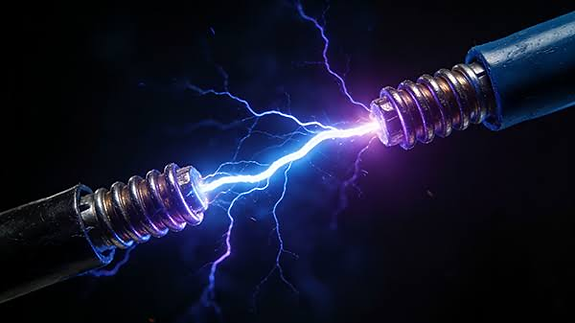
Conveniently, we shall learn about the safety concern, first. That is the very real public safety risk and commercial risk of quantum power drainage or quantum power sink.
Please test all new or conceptually challenging principles on a scale electronic breadboard model for quick reference. They are available online (including from Amazon). Transmission is currently delivered at long wavelength. It should be transmitted at ultra short wavelength at lower amplification for greatest efficiency, so that it short circuits the very resistive and heat and resistance generating capacitors. (That is simply lower voltage and higher alternating current.)
Instead it will pass the air-core inductors or solenoids (larger inductors). The power transmission will run cool, by comparison with today's example. Please test this with a thermometer and record as video documentation.
To prevent power loss due to quantum inductive leakage, the entire power grid should operate with a voltage, private network. That is a voltage VPN.
An antenna is not orthodoxly the wire loop. It is more correctly the power loop with its specific voltage and current configuration which forms the active antenna. Communications technology of all kinds is antenna matching. It shares no wave configuration with another power flux network, and it will consequently remain unentangled, Entanglement, derived from wave parity or replication would lead to power sharing between the set of wave replicates.
Test the principles on a scale model of the grid, if unsure of the realisation of that previous concept.
*** The most favourable, working model illustrates the clear necessity for private network power sequestration versus open network power sharing.
The sharing ratio is according to the number of actively tuned devices and their individual and active power gains. Private network theory should be clearly demonstrating to be a Law of Electromagnetic Power Entanglement. ***
See the article referring to Quantum Communications to attain insight into how to quantum transmit any signal, including power, over an electronic or electrical network pairs.
Quantum physics is the study of uniformly amplified waveforms.
© Sydney Matinga 2025


Comments